
What Chinese herbal medicine is
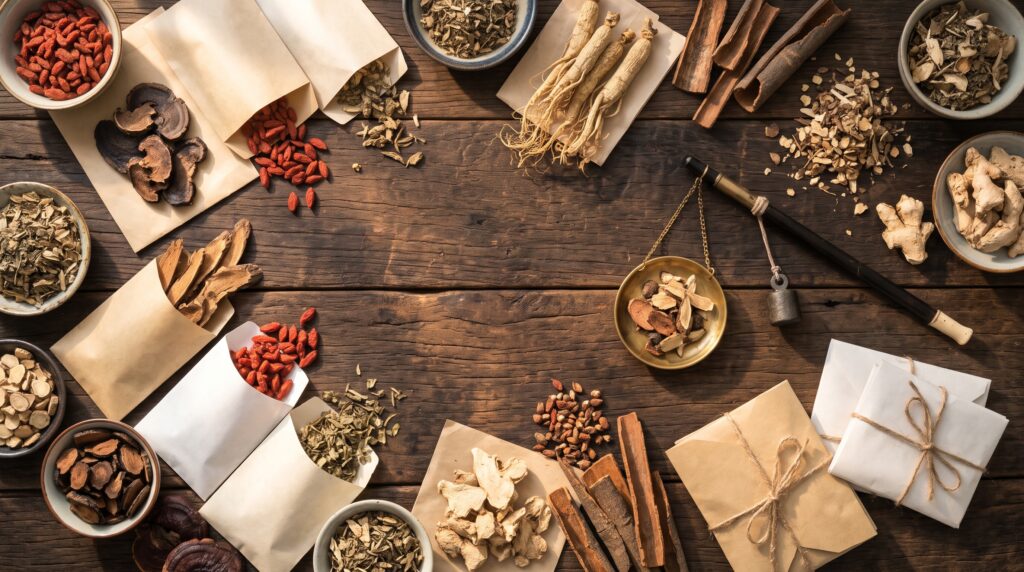
Herbal medicine has been part of TCM for over two thousand years, with classic texts cataloguing hundreds of commonly used substances. Most are plant-based — roots, bark, flowers, seeds, fruits, and leaves — though some traditional formulas include minerals or animal products, which reputable modern clinics will disclose and can usually substitute.
One important distinction: this is not the same as grabbing a supplement bottle off a shelf. In TCM, herbs are almost never prescribed one at a time, and they’re not prescribed for a disease label. They’re prescribed for a pattern — the practitioner’s overall read of what’s out of balance in your body right now. Two people with the same Western diagnosis, say insomnia, may walk out with completely different formulas. That’s normal in this system.
How a formula is put together
Think of a formula like a team rather than a solo act. A classic formula has herbs in different roles:
- Chief herbs do the main job and address the core of the pattern.
- Supporting herbs help the chiefs, or handle secondary symptoms.
- Balancing herbs soften the formula — for example, protecting digestion so stronger herbs don’t upset your stomach.
- Guiding herbs are traditionally said to direct the formula’s action toward a particular area of the body.
Practitioners usually start from a classical base formula — some have been in continuous use for centuries — and then add, remove, or adjust ingredients based on your symptoms, tongue and pulse findings, and how you respond over time. Formulas are meant to change as you improve; a prescription that never changes over months is worth a question.
From a modern point of view, the chemistry is real: herbs contain active compounds, which is exactly why they can both help and interact with medications (more on that below). But the research picture is uneven. Individual herbs and a few formulas have been studied in clinical trials with mixed results, while most traditional combinations have never been tested in large, rigorous studies. Long traditional use is meaningful background, not proof. Be skeptical of any clinic that promises herbs will cure a serious disease.
The forms you’ll actually see in Calgary
- Raw herbs (decoction): A paper bag of dried ingredients you simmer at home into a dark tea. The most traditional and most customizable form — and the most effort, with a strong taste many people describe as an acquired one.
- Granules: Concentrated powdered extracts you dissolve in hot water. Nearly as customizable, far more convenient, and very common in Calgary clinics.
- Pills and capsules: Ready-made classical formulas. Convenient and mild-tasting, but fixed — they can’t be adjusted to you the way a custom formula can.
- Tinctures and topical products: Alcohol-based liquid extracts, plus liniments and plasters applied to the skin for aches and injuries.
Your practitioner will explain how and when to take what you’re given, and for how long before checking back in.
Who should be careful — this part matters
“Natural” does not mean harmless. Herbs are pharmacologically active, and this is where Chinese herbal medicine deserves the most respect:
- Medication interactions are the big one. Some herbs can affect blood thinners, blood-pressure and diabetes medications, immunosuppressants, and other prescriptions. Always tell your herbal practitioner every medication and supplement you take — and tell your doctor and pharmacist that you’re taking herbs.
- Pregnancy and breastfeeding: A number of herbs are considered unsafe during pregnancy. Don’t self-prescribe, and make sure your practitioner knows.
- Liver or kidney conditions: Mention them. Your practitioner may avoid certain herbs or suggest monitoring.
- Source quality varies. Herbal products sold through practitioners are generally held to higher standards than random online imports, which have occasionally been found contaminated or spiked with undeclared drugs. In Canada, look for products with a Natural Product Number (NPN) on the label, issued by Health Canada.
- Don’t stop or replace prescribed medication with herbs on your own. Herbal medicine works best as a complement to, not a substitute for, medical care for serious conditions.
In Alberta, acupuncture is regulated under the College of Acupuncturists of Alberta, and herbal prescribing is commonly offered by practitioners with specific TCM herbal training. Ask about their training in herbal medicine before accepting a prescription — it’s a fair question and a good sign if they answer it clearly.
Frequently asked questions
Does the tea taste bad?
Honestly, often yes — decoctions tend to be bitter and earthy. Granules are usually a bit easier, and pills easiest of all. Most people adapt within a few days, and you can ask your practitioner about taking your dose after a small amount of food if it bothers your stomach (unless they advise otherwise).
How long before I notice anything?
It depends on the problem. Digestive or sleep complaints sometimes shift within a week or two; long-standing issues usually take longer and are reviewed visit by visit. If nothing has changed after a reasonable trial your practitioner suggests, it’s fair to ask whether the formula should change — or whether herbs are the right tool at all.
Can I take herbs together with my prescriptions?
Sometimes, but only with full disclosure on both sides. Bring a list of your medications to your appointment, and loop in your pharmacist — they’re excellent at spotting interactions. Never quietly combine the two and hope for the best.
If herbs are natural, aren’t they automatically safe?
No. Many modern drugs were originally derived from plants, and “active enough to help” also means “active enough to interact.” Dose, quality, and your own health conditions all matter, which is why individualized prescribing exists in the first place.
Do I have to do acupuncture too?
No. Herbs and acupuncture are often combined — many Calgary clinics offer both in one visit — but each can stand alone, and your practitioner should be fine with whichever you choose.
Curious what practitioners near you offer? Browse Calgary clinics in our clinic directory.
