
Where acupuncture comes from
Acupuncture has been practised in China for well over two thousand years, and it’s one part of a bigger system — TCM also includes herbal medicine, cupping, tuina massage, and dietary advice. That’s why many Calgary clinics offer several of these under one roof.
In the traditional framework, health depends on the smooth flow of energy (called qi, pronounced “chee”) and blood through pathways called meridians. When flow gets blocked or out of balance, pain and illness are said to follow. Needles at specific points along those pathways are meant to restore the flow.
You don’t have to buy into the traditional explanation to try acupuncture. Plenty of patients treat it as a physical therapy and judge it purely on whether they feel better afterwards. Both viewpoints are common in Calgary clinics, and a good practitioner won’t mind which one you hold.
How it might work — and what the research says
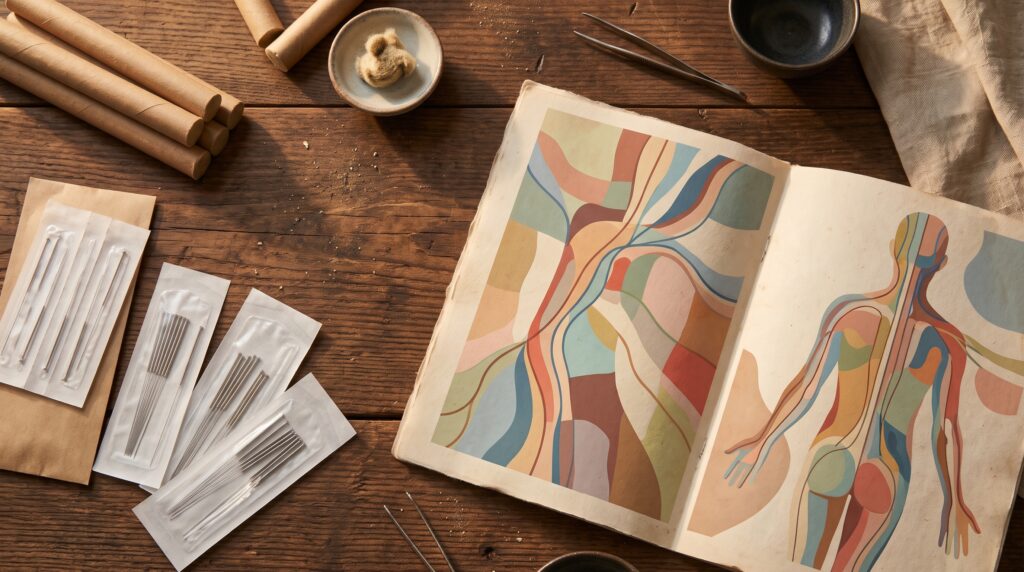
Modern science doesn’t confirm the traditional meridian system, but researchers have proposed other explanations: needling may stimulate nerves and connective tissue, briefly increase local blood flow, and prompt the release of the body’s own pain-modulating chemicals. None of these theories fully explains it, and research is ongoing.
So does it work? The honest answer is: it depends on the condition, and the evidence is mixed. Systematic reviews find modest benefits for some chronic pain conditions, such as back and neck pain, knee osteoarthritis, and some headaches, and a few major clinical guidelines list acupuncture as a non-drug option for chronic pain. Skeptics point out, fairly, that in many studies acupuncture performs only slightly better than “sham” needling (needles placed at non-traditional spots), which suggests part of the benefit may come from context and expectation — the so-called placebo effect. Benefits also vary a lot from person to person.
A reasonable takeaway: acupuncture is generally considered low-risk when performed by a trained, registered practitioner, and some people get meaningful relief from it. It isn’t a miracle cure, and it shouldn’t replace medical care for serious or undiagnosed problems.
What a session is actually like
A first visit usually starts with a conversation. The practitioner asks about your main concern, your sleep, digestion, stress, and general health — TCM looks at the whole picture, not just the sore spot. They may look at your tongue and take your pulse at both wrists, which are traditional assessment methods.
Then you’ll lie on a treatment table, fully or partially clothed depending on where the points are. The needles are hair-thin, sterile, and single-use — each one comes out of a sealed package and is thrown away after your session. Insertion is usually quick, with a brief pinch or nothing at all. Once the needles are in (often somewhere between a handful and a couple of dozen), you’ll rest quietly for about 20 to 40 minutes. Many people doze off.
A dull ache, heaviness, warmth, or a mild tingling around a needle — a sensation traditionally called deqi — is considered normal. Sharp pain is not; always speak up if something feels wrong.
One session rarely settles a long-standing problem. Practitioners commonly suggest a short course of visits, then reassess. Be wary of anyone who pressures you to prepay for a very large package up front.
Who should be careful — or skip it
Acupuncture is low-risk for most healthy adults, but tell your practitioner if any of these apply:
- You take blood thinners or have a bleeding disorder — bruising is more likely, and needling may need adjusting or avoiding.
- You’re pregnant — some points are traditionally avoided during pregnancy, so your practitioner needs to know.
- You have a pacemaker — this matters mainly for electroacupuncture, where needles are connected to a mild electrical current.
- You have a severe needle phobia — there are needle-free options in TCM, like acupressure or tuina, that may suit you better.
- The area is infected, broken, or freshly injured — needles won’t go there.
In Alberta, acupuncture is a regulated health profession. Look for a registered acupuncturist registered with the College of Acupuncturists of Alberta — registration means they met provincial education and safety standards, and it’s often required for extended health insurance claims. If someone can’t tell you where they’re registered, go elsewhere.
Frequently asked questions
Does acupuncture hurt?
For most people, no — the needles are far thinner than the ones used for blood tests. You might feel a tiny pinch going in and a dull, heavy, or warm feeling afterwards. Sharp or lasting pain is not expected; tell your practitioner right away.
How many sessions will I need?
It varies. A recent issue might improve in a few visits; a problem you’ve had for years usually takes longer. A trustworthy practitioner will set expectations up front and check in on progress rather than booking you indefinitely.
Is acupuncture covered in Alberta?
Routine acupuncture at private clinics is generally not covered by the Alberta Health Care Insurance Plan. Many employer extended health plans do cover it, usually when it’s provided by a registered acupuncturist. Check your own plan for details.
Are the needles reused?
No. Practitioners in Alberta use sterile, single-use disposable needles, opened in front of you and discarded after one session. If you ever see anything different, leave.
What should I wear or bring?
Loose, comfortable clothing that can be rolled up to the elbows and knees covers most point locations. Eat a light meal beforehand — arriving hungry or stuffed can make you feel faint or uncomfortable while resting with needles in.
Ready to see what’s available near you? Browse Calgary clinics in our clinic directory.
