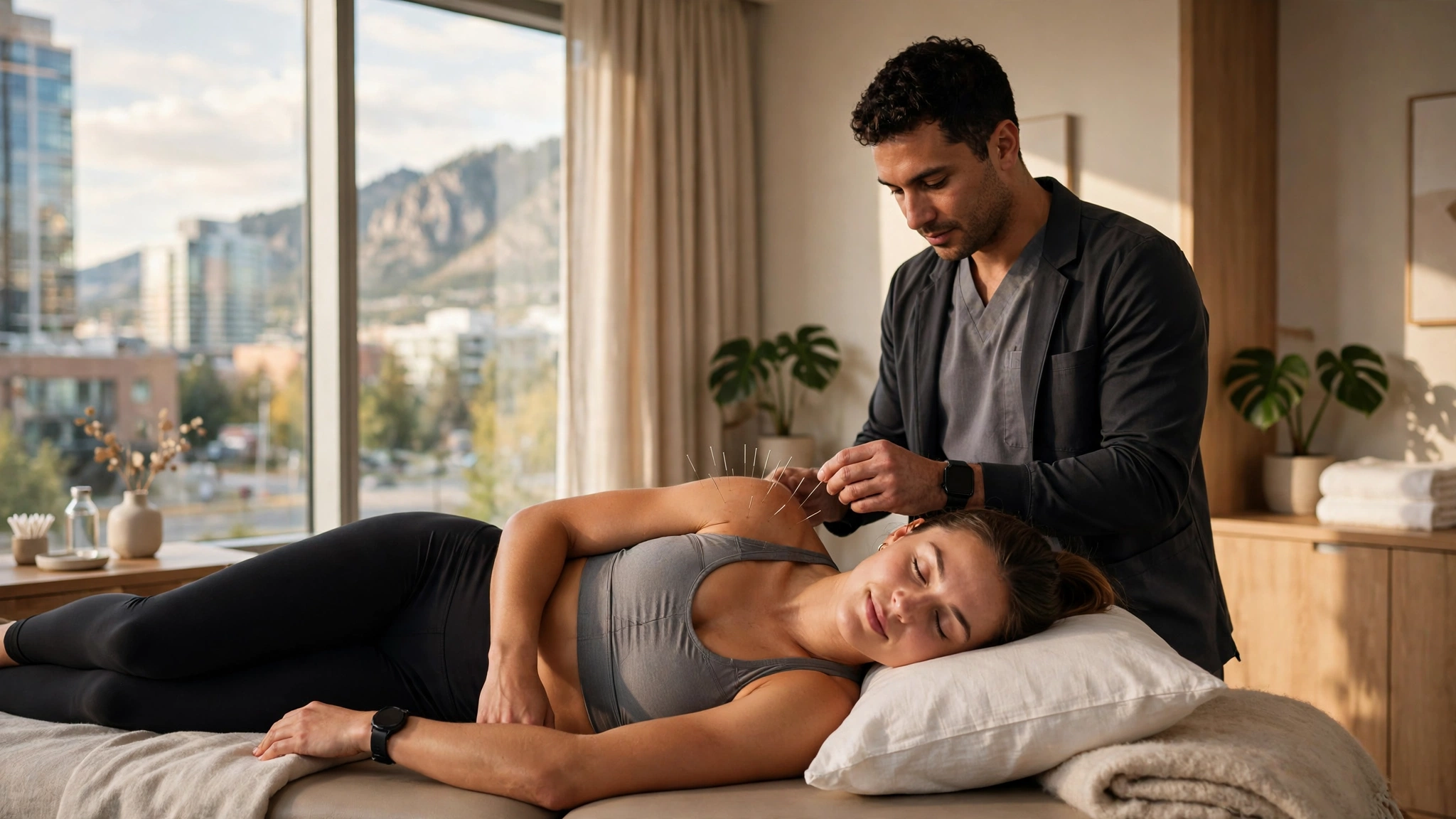
If you train or compete in Calgary — hockey, running, soccer, skiing, lifting, or weekend league — an injury can stall everything fast. That is why many local athletes look into acupuncture for sports injuries: not as a replacement for assessment and rehab, but as an add-on that may ease pain and stiffness during recovery. This guide covers which injuries people bring in, what the research shows, and the warning signs that should go to a doctor first.
Which sports injuries bring Calgary athletes in?
Most visits are for stubborn problems rather than emergencies. Sprains and strains top the list — a rolled ankle, a pulled hamstring or calf, a sore lower back after deadlifts. Overuse problems are just as common: tendinopathy in the Achilles, knee, elbow, or shoulder; runner’s knee; shin splints; stiff necks from training plus desk work. Calgary’s seasons shape the mix — winter brings ski, hockey, and icy-sidewalk injuries; summer brings running and soccer volume and flare-ups when mileage jumps too quickly. One boundary matters: a suspected fracture, dislocation, complete tear, or head injury needs medical assessment first. Acupuncture enters after the injury is understood.
What acupuncture for sports injuries can and cannot do
Here is the honest version. The best-studied example is the ankle sprain. A systematic review and meta-analysis of randomized trials (Park and colleagues) found acupuncture showed benefit for symptom improvement when added to other treatment — but the benefit versus other treatments alone was probably overestimated, because the trials varied a lot and carried a high risk of bias. Their conclusion: insufficient high-quality evidence supports it as a stand-alone alternative.
A 2020 review focused on athletes gathered 22 case reports and case series — shoulder pain, calf strain, tendinopathy, meniscus injury, sports hernia, ankle injury, muscle soreness. Reports were generally positive, but case reports have no control group, and athletes were usually receiving other care at the same time — so you cannot tell how much was the needles versus natural healing, rest, or rehab. The reviewers concluded it shows potential, but stronger research is needed.
Guidelines reflect that caution. The UK’s NICE recommends considering acupuncture only for a narrow set of pain conditions, such as chronic primary pain — not as a general sports-injury treatment. Skeptics add a fair point: many injuries improve with time and progressive loading anyway, some reported benefit is likely placebo effect, and no good evidence shows it speeds tissue healing, prevents re-injury, or guarantees an earlier return to play. The reasonable expectation is narrower: for some people, short-term pain relief and looser movement that make rehab exercises easier to do well. Our review of acupuncture for lower back pain applies the same standard: modest help for some, not a cure.
What a session actually looks like
A first visit starts with history and assessment: what happened, where it hurts, what movements are limited, what imaging or diagnoses you already have, and what your sport demands. If the problem has not been assessed and the picture is unclear, expect a referral out first.
Treatment usually combines points near the injured area with points elsewhere, sometimes with electroacupuncture (a mild current through the needles) or add-ons such as cupping — our explainer on cupping and gua sha in Calgary covers those. Needles are sterile and single-use; most people feel a dull ache or tingling rather than sharp pain. Bruising, soreness, or brief light-headedness are the common minor effects. Mention blood thinners, bleeding disorders, or a pacemaker if electroacupuncture is proposed. Unsure whether you are booking acupuncture, dry needling, or IMS? Our comparison of acupuncture vs. dry needling vs. IMS explains who does what in Alberta.
Where it fits beside physio, rehab, and rest
Think of recovery as layers. Assessment and diagnosis come first. Rehab — progressive loading, mobility work, strength, and a graded return to your sport — does the heavy lifting for most sprains, strains, and tendinopathies. Acupuncture, if you use it, sits alongside: pain relief and reduced stiffness that help you complete your rehab. Keep your physiotherapist in the loop, and do not use a good day after treatment as permission to skip progressions — feeling looser is not the same as tissue being ready. Set a review point, too: if several sessions produce no change, that is useful information. Our guide on how many acupuncture sessions you need explains how to judge progress and when to stop.
When to get medical care first
Get prompt medical care — before booking acupuncture — if you notice: a limb or joint that looks bent or out of place; bone visible or a deep wound; inability to bear weight or use the limb; severe or rapidly increasing pain or swelling; numbness, tingling, or weakness below the injury; fingers or toes that look pale or feel cool; or bleeding that does not stop with pressure. These can signal a fracture, dislocation, or nerve damage.
Head injuries are their own category. Headache, dizziness, nausea, confusion, balance problems, or sensitivity to light or noise after a hit can be concussion signs. The Centers for Disease Control and Prevention recommends removing an athlete with a suspected concussion from play immediately and keeping them out for the rest of the day, returning only after evaluation and clearance. Worsening headache, repeated vomiting, increasing confusion, slurred speech, seizures, or one pupil larger than the other are emergency signs — call 911. Also get checked if pain is sharp over a bone, a knee locks or gives way, or pain keeps worsening.
Choosing a practitioner in Calgary for a sports injury
In Alberta, acupuncture is a regulated profession. Confirm your practitioner is registered with the College of Acupuncturists of Alberta, and ask about their sports-injury experience: Have you treated this injury before? How will you work with my physio plan? What change should I notice, and by when? What would make you refer me back for imaging? Good answers are specific. Expect a trial of a few sessions with a review date — not pressure to buy a large prepaid package, not a guaranteed return date, and not advice to drop other care.
Frequently asked questions
Can acupuncture speed up healing after a sports injury?
That has not been proven. Reviews suggest it may ease pain and improve short-term function for some injuries, especially as an add-on, but evidence that it speeds tissue healing or shortens time away from sport is limited. Rehab and time do the main healing work.
Should I get acupuncture right after spraining my ankle?
Get the sprain assessed first, especially if you cannot bear weight, swelling came up fast, or pain sits right over a bone — a fracture can look like a bad sprain. Once a serious injury is ruled out, acupuncture is sometimes used alongside standard sprain care, but evidence for it alone is weak.
Is acupuncture better than physiotherapy for sports injuries?
They do different jobs, so it is not either-or. Physiotherapy provides assessment, exercise progressions, and return-to-sport planning — the core of most recoveries. Acupuncture is an optional add-on for pain and stiffness; dropping rehab for needles alone is not supported by the evidence.
How many sessions will I need for a sports injury?
There is no fixed number, and anyone who quotes a long course up front should be questioned. A sensible pattern is a few sessions with a clear review point: if pain, movement, and function are not improving, reassess instead of continuing.
Does acupuncture hurt, and is it safe for athletes?
Most people describe a dull ache, heaviness, or tingling rather than sharp pain. With a registered practitioner using sterile, single-use needles, serious problems are uncommon; minor bruising or soreness is typical. Mention blood thinners or a pacemaker before treatment.
Ready to explore options? Browse our clinic directory to find registered clinics across Calgary.
