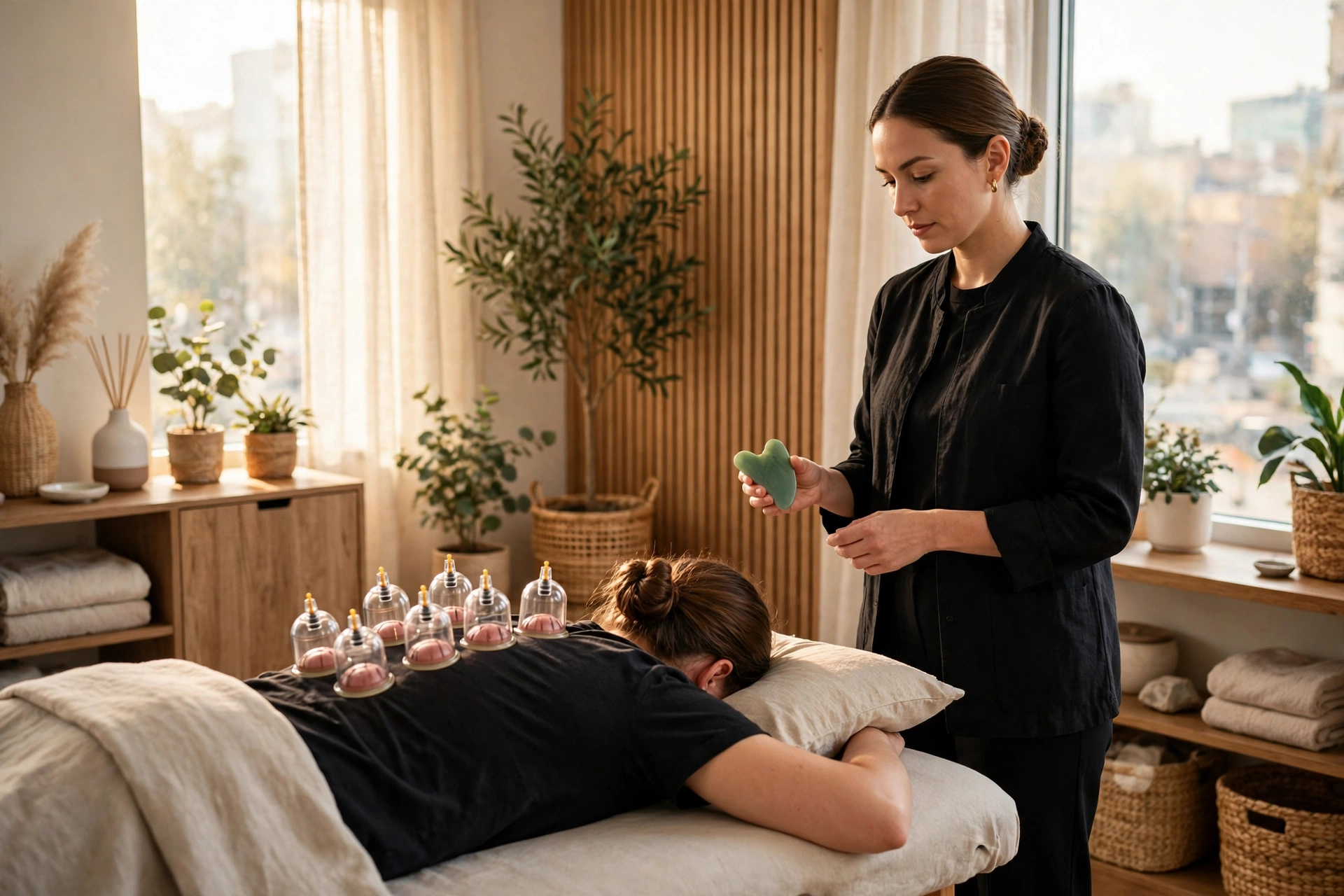
If you are looking into cupping and gua sha in Calgary, you have probably seen the photos — round purple circles from cups, or red streaks after scraping — and wondered two things: what does it cost, and what is it actually for? This guide answers both, with a clear-eyed look at the evidence.
Cupping and gua sha are two of the most common add-on therapies in traditional Chinese medicine (TCM), often offered in the same visit as acupuncture or tuina massage. They are different techniques, but people usually try them for the same reason: stiff, sore, tight muscles that will not quite let go.
What cupping and gua sha actually are
Cupping uses small cups — glass, plastic, or silicone — placed on the skin. Suction is created with a pump or, in traditional fire cupping, with a brief flame. The suction lifts the skin and tissue underneath. Cups may stay in one spot for several minutes or glide over oiled skin. The round marks that follow are bruises: tiny blood vessels under the skin break under the suction, just like any other bruise.
Gua sha uses a smooth-edged tool — often stone or ceramic — drawn in firm strokes over lubricated skin, usually along muscles or acupuncture meridians. The strokes bring up redness and small spots called petechiae, sometimes described as “sha.” On the body, gua sha is used mainly for muscle tension and pain. Facial gua sha is much lighter and is a separate cosmetic routine.
In traditional terms, both are said to move stagnant blood and qi. In plain modern terms, they increase local blood flow and apply strong stimulation to tight tissue. For deeper background, see our guide to cupping therapy and what those round marks mean.
Cupping and gua sha in Calgary: what they cost
Prices vary by clinic, session length, and whether the therapy is an add-on or the main treatment, so always confirm the current rate when you book. Based on publicly posted Calgary price lists checked in October 2026:
- As an add-on to acupuncture or massage, cupping or gua sha commonly runs about $30 to $60. Some clinics include a short cupping set in a regular acupuncture visit at no extra charge.
- As a standalone session, cupping costs more, because you are paying for a full appointment. Posted Calgary examples include roughly $70 to $80 for 30 minutes and $100 to $115 for 60 minutes.
- Gua sha is most often priced as part of an acupuncture or massage visit rather than as a separate line item. If listed, it usually sits in the same add-on range as cupping.
Two cost questions are worth asking before you book. First, is the therapy billed under acupuncture or massage for insurance purposes? That affects whether an extended health plan will reimburse it. Second, does your plan require a registered practitioner? In Alberta, cupping and gua sha offered as TCM care are typically provided by registered acupuncturists, and massage-based cupping by registered massage therapists. Our walkthrough of your first acupuncture visit in Calgary explains where add-ons fit in a first appointment.
What do people use them for?
In Calgary clinics, cupping and gua sha are used most often for:
- Lower back pain and stiffness
- Neck and shoulder tension, including desk-worker tightness
- General muscle soreness and tight spots that massage does not quite reach
That list is about common use, not proven results — and the difference matters.
What the evidence actually says
Here is the balanced view. The U.S. National Center for Complementary and Integrative Health (NCCIH) notes that there has been some research on cupping, but most of it is of low quality. Cupping may help reduce pain, but the evidence is not very strong, and there is not enough high-quality research to draw conclusions about other conditions. Some reviews have found cupping for back pain did better than usual care, while other trials found it no better than sham cupping — which is why reviewers urge caution.
For gua sha, the research base is even smaller: a handful of small, short studies, sometimes with short-term improvements. Skeptical reviewers note that wide claims — for infections, internal disease, or lasting detox — have no good evidence behind them. Supporters, including many patients, report real short-term relief from tight, achy muscles. That experience is not nothing — it just is not the same as proof.
A sensible framing: both are low-risk comfort measures for muscle aches and tension for most healthy adults, sometimes genuinely helpful for short-term relief. They are not proven treatments for disease, and they should not delay medical care for pain that is severe, unexplained, or getting worse. And no — the marks are not toxins leaving your body. Your liver and kidneys handle detox around the clock.
Marks, side effects, and who should skip it
Both therapies leave marks, and you should plan around them. Cupping marks range from faint pink to deep purple and usually fade over several days, occasionally up to about two weeks. Gua sha redness and bruising also typically clear within a few days. If you have photos, a wedding, or a backless outfit coming up, book after the event or ask for lighter treatment.
Other side effects are usually minor but real. NCCIH lists persistent skin discoloration, scars, burns (mainly with fire cupping), and infections among reported cupping side effects, and notes cupping may worsen eczema or psoriasis. Gua sha done too aggressively can damage skin, and poorly cleaned tools raise infection risk with either therapy.
Talk to your practitioner — and your doctor — first if you:
- Take blood thinners or have a bleeding disorder, since both therapies mean bruising
- Have broken, sunburned, infected, or very fragile skin in the treatment area
- Are pregnant, since treatment over the abdomen and lower back is generally avoided
- Have varicose veins, a history of blood clots, eczema, or psoriasis in the area
A good clinic explains the marks beforehand, uses clean equipment for each client, and adjusts pressure when you speak up. Treatment should feel strong, not painful.
Frequently asked questions
How much does cupping cost in Calgary?
As an add-on, cupping commonly costs about $30 to $60 based on publicly posted Calgary prices checked in October 2026. Standalone sessions run roughly $70 to $115 depending on length. Confirm the current rate when you book.
Does cupping or gua sha hurt?
Cupping feels like a firm pulling or tightness that usually settles after the first few seconds. Gua sha feels like strong, repeated pressure along the muscle. Neither should be painful. If suction or pressure feels too strong, say so — your practitioner can ease off right away.
How long do cupping and gua sha marks last?
Cupping marks usually fade over several days and can take up to about two weeks if they are dark. Gua sha redness and bruising typically clear within a few days. Lighter treatment leaves lighter marks, so mention it if timing matters.
Are cupping and gua sha covered by insurance in Alberta?
Alberta Health does not cover these therapies at private clinics. An extended health plan may reimburse the visit if cupping or gua sha is billed as part of acupuncture or massage treatment by a registered practitioner, but plans differ. Ask the clinic how the visit will be billed and check your plan before you rely on coverage.
Which should I try first, cupping or gua sha?
It depends on the area. Cupping is often chosen for the back and shoulders, where cups sit well on broad tight areas. Gua sha follows the shape of muscles and reaches smaller areas cups cannot. Many practitioners use both in one visit and can suggest a starting point after assessing you.
Ready to compare your options? Browse our clinic directory to find Calgary acupuncture and TCM clinics near you.
