
If your lower back aches most days, you have probably wondered whether acupuncture for lower back pain actually works. This review looks at what the research says — the encouraging findings, the limits, and the skeptical view — so you can decide with clear eyes.
The short answer first
For chronic lower back pain — pain lasting more than three months — the evidence is moderately supportive. Reviews find acupuncture tends to help more than no treatment, and can improve back function compared with usual care alone. The benefit is usually modest rather than dramatic, and researchers still debate how much comes from the needles versus the overall treatment experience.
For acute pain — a recent strain — the evidence is weaker and more mixed. Some people report quick relief, but the studies are lower quality. It should not replace an assessment if your pain followed an injury or is getting worse.
What the big reviews found
The U.S. National Center for Complementary and Integrative Health (NCCIH) summarizes the research this way: a 2020 Cochrane review looked at 33 studies with 8,270 participants with chronic low-back pain. Compared with no treatment, acupuncture produced greater pain relief and better back function. Compared with usual care, it improved function, but the extra pain relief was not large enough to count as clinically meaningful — noticeable on a chart, but not necessarily life-changing. Compared with sham acupuncture, designed not to count as real treatment, there was no clinically meaningful difference.
Other reviews lean a little more positive. A systematic review prepared for the 2017 American College of Physicians guideline, covering 32 randomized trials with more than 6,000 participants, found modest short-term effects on pain. An updated meta-analysis in 2018, covering 39 trials and 20,827 patients, concluded that acupuncture is effective for low-back pain, with effects lasting over time. A 2020 review by the U.S. Agency for Healthcare Research and Quality found slightly greater improvements in pain and function at one to six months compared with controls.
Put together: people with chronic pain who receive acupuncture generally do somewhat better than people who receive nothing, and often a little better than usual care alone. No honest review promises it works for everyone, or that the effect is large.
What guidelines say — and where they disagree
The American College of Physicians includes acupuncture among the non-drug treatments to try first for chronic low back pain, before medication, alongside options such as exercise, spinal manipulation, and mindfulness-based approaches. For acute and subacute pain, it also lists acupuncture as an option, while rating the supporting evidence as lower quality.
Not every guideline agrees. The United Kingdom’s National Institute for Health and Care Excellence (NICE) advises against offering acupuncture for low back pain, with or without sciatica. Skeptics point to the sham studies: when real acupuncture barely outperforms pretend acupuncture, they argue, much of the benefit may come from expectation, rest, attention, and the ritual of care rather than from specific needle placement.
Supporters answer that sham needling is not truly inactive — lightly needling the skin may itself affect pain — and that patients care about whether they hurt less and move better, not only about which part of the treatment caused it.
The practical takeaway: acupuncture for lower back pain is a low-risk option with modest support for chronic pain, not a proven cure and not a replacement for diagnosing why your back hurts.
Acupuncture for lower back pain: what a course of treatment looks like
In Calgary, a first visit starts with questions about where the pain sits, how long it has been there, and what makes it better or worse. A TCM practitioner may also look at your tongue and feel your pulse, which are part of TCM assessment.
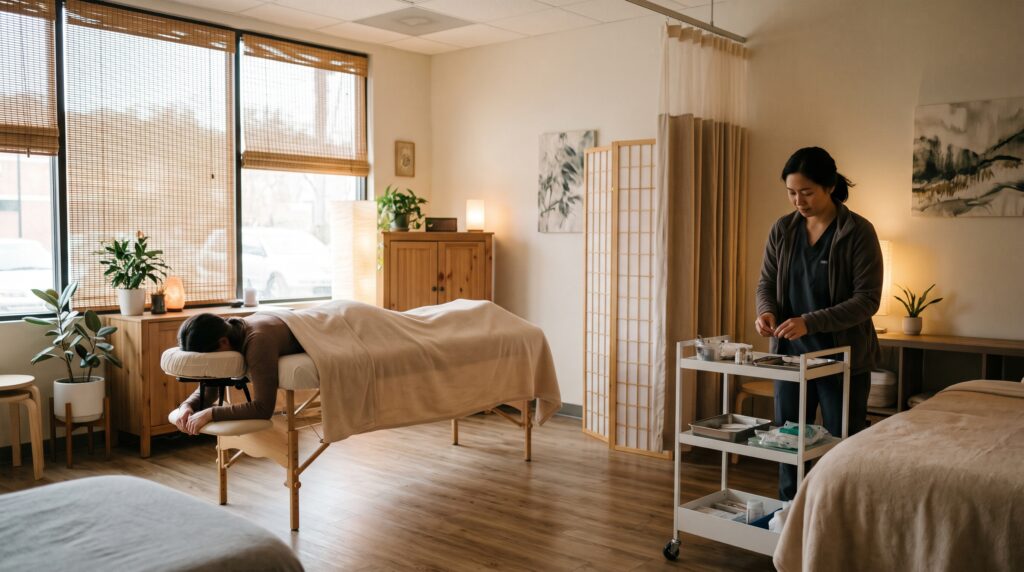
Treatment involves very thin, sterile, single-use needles placed at points on the back, legs, and sometimes other areas, because in TCM theory points along a channel can affect pain elsewhere. You then rest with the needles in place. Many people describe a dull ache, warmth, or heaviness rather than sharp pain, though experiences vary.
Because chronic pain rarely changes after one visit, practitioners usually suggest a short course, then a review: is pain easing, is movement improving, are you sleeping or working more comfortably? If nothing has changed after a reasonable trial, it is reasonable to stop and try something else. Be cautious of any clinic that guarantees a cure or pressures you into a large prepaid package.
Safety and when to get checked first
Acupuncture has a good safety record when performed by a trained, regulated practitioner using sterile, single-use needles. Common side effects are minor, such as small bruises or brief soreness. In Alberta, acupuncture is a regulated profession, so check that your practitioner is registered and in good standing.
If your pain travels down your leg, it may be sciatica rather than simple back pain — see our evidence review of acupuncture for sciatica for how the research differs there.
Some back pain, however, needs medical attention before anything else. Get assessed promptly if your pain follows a significant fall or collision, if you have fever, unexplained weight loss, or a history of cancer, if pain is severe or steadily worsening, or if you develop leg weakness, numbness in the saddle area, or changes in bladder or bowel control. Acupuncture is not a substitute for investigating those warning signs.
Keep the basics in view too: staying as active as your pain allows, building strength gradually, and addressing sleep and stress often matter as much as any single therapy.
How to decide if it is worth trying
Consider a trial if your pain has lasted more than a few months, if you prefer non-drug options first, and if you will judge the result by function — walking farther, sitting through a workday, getting back to activities you miss — rather than by pain dropping to zero. Set a simple goal before you start and agree on when you will review progress. That turns a vague hope into a fair test, whichever way the result goes.
Frequently Asked Questions
Does acupuncture work better for chronic or acute back pain?
The evidence is stronger for chronic pain that has lasted more than three months. For acute pain, the evidence is lower quality and more mixed, even though some people report short-term relief.
How many sessions will I need before I know if it helps?
There is no proven number that works for everyone. A common, sensible approach is a short course of treatment followed by an honest review of pain and function. If there is no change at all, it is reasonable to stop.
Is acupuncture better than sham acupuncture?
In the 2020 Cochrane review summarized by NCCIH, real acupuncture did not produce a clinically meaningful advantage over sham for chronic low-back pain. Some other reviews found small advantages. This is why experts debate how the benefit happens.
Can acupuncture replace medication or physiotherapy?
Guidelines place acupuncture among the non-drug options to try, often alongside exercise and other care, rather than as a replacement for an assessment or for treatment your doctor has recommended. Talk with your care team before changing any prescribed medication.
Is acupuncture safe for back pain?
It has a good safety record when performed by a trained, regulated practitioner using sterile, single-use needles. Minor bruising or soreness can occur. Back pain with warning signs — such as after a serious injury, or with leg weakness or bladder changes — should be assessed medically first.
Ready to explore your options nearby? Browse the clinic directory to find registered acupuncture clinics across Calgary and compare what each one offers.
